
Waiheke Island
At a time when ''rich man islands'' loom large in our imagination what sort of place is this?

You’d be forgiven for thinking that Waiheke Island, where most of the events regarding, Gaiman, Palmer and Pavlovich transpired, is some tiny private island. At a time when the world’s attention is focused on the Epstein files, with much of the crimes there taking place on Little St James, at a casual glance you might think the cases bore an uncanny resemblance.
After all, both take place on ‘‘rich people islands’’. Lila Shapiro is quick to point out that it is a wealthy enclave:
Waiheke Island, a lush bohemian retreat with vineyards, golden beaches, and more than 60 helipads to accommodate the billionaires who vacationed there.
And then, by the time of Pavlovich’s civil tort case in February 2025, the hitherto unmentioned accusation of human trafficking against both Palmer and Gaiman had emerged - drawing further comparison.
So in an emotionally turbulent time, the world audience is almost primed to see these as variations on a theme. A rich man, with a female enabler (the Ghislaine Maxwell - Palmer comparison is often made), in a rich man’s playground - beyond the reach of law.
What would you do as Lila Shapiro or Rachel Johnson? Would you carefully explain the differences beyond such surface resemblance. Or would you subtly allow it to simmer. What gets more clicks?
Crucial differences, such as that Pavlovich was almost 24 rather than a child, are easily smoothed over. The more ones pokes around the case, the more the comparisons drop away, and it begins to look suspicious in and of themselves that they were ever evoked.
Is Waiheke Remote?
In her complaint document, submitted to the courts in her civil tort case, Molly Scarlett Pavlovich writes.
40. Waiheke Island is an island near Auckland, New Zealand that many wealthy people favor as a residence because it is remote and difficult to access.
Throughout the complaint document she paint a picture of herself as trapped and isolated on a remote island. A rich man’s island. The only problem is that Waiheke is one of the least remote places in New Zealand.
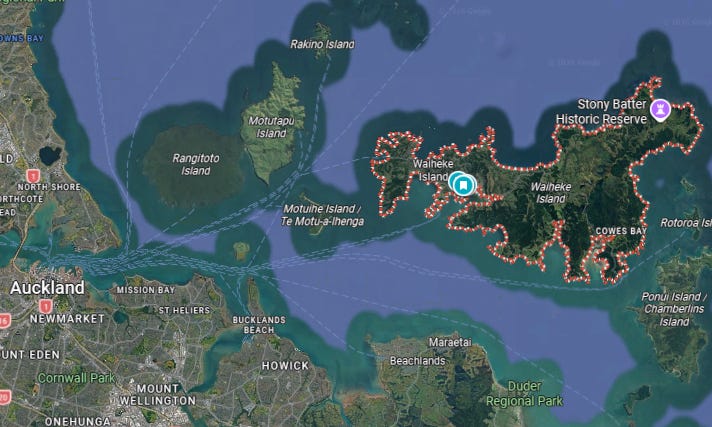
Auckland is not the capital of New Zealand, but it is the most populous city at 1.7 million. It’s possible to commute from Waiheke to Auckland, and some do this - the only major barrier being ferry tickets at 46 NZ dollars return, approximatively 26 USD. Some will go to see a show, eat a meal, and then return to the island in the late evening.
The ferry is about a 40 minute ride, and will drop you right in central Auckland.
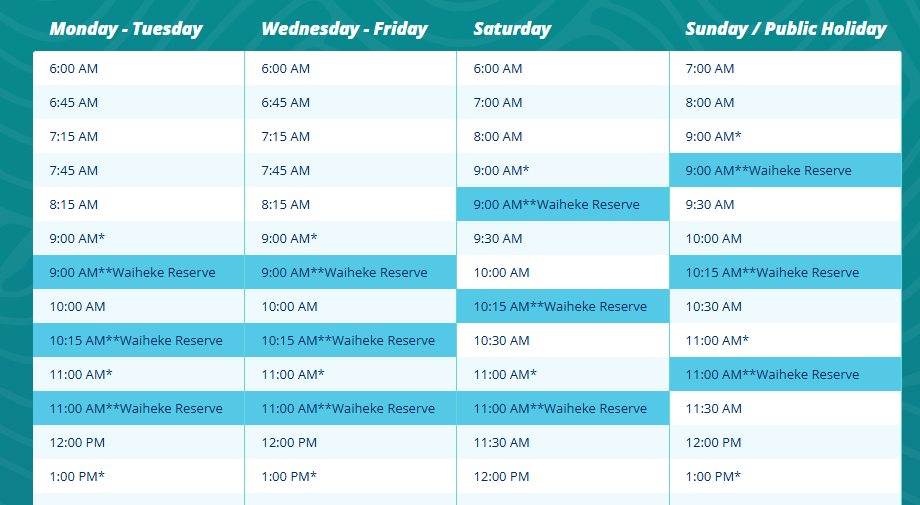
As you can see, the ferries go frequently.
And the last ferry is very late.
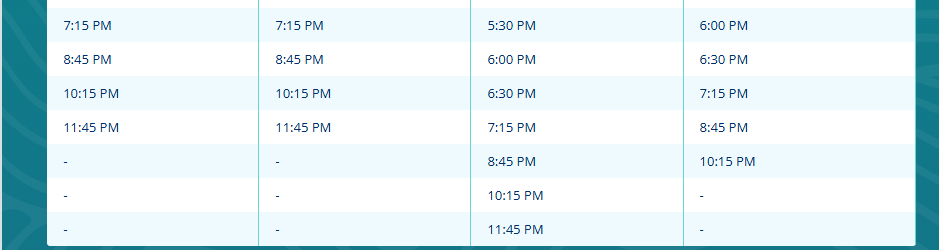
The island is neither remote nor difficult to access. In fact, it operates a tight, regular service to the most densely populated part of New Zealand.
But also, Pavlovich knows this. She grew up near Auckland and took trips there as a teenager.
Was Gaiman’s House Remote?
What’s referred to as the Pōhutukawa House in WhatsApp messages, is 10 Hillside Road, Ostend. It’s where Neil Gaiman lived while he was on the island.
While Waiheke itself is not hard to access, there is a much more barren and sparsely populated eastern side to the island. So where did Gaiman live?
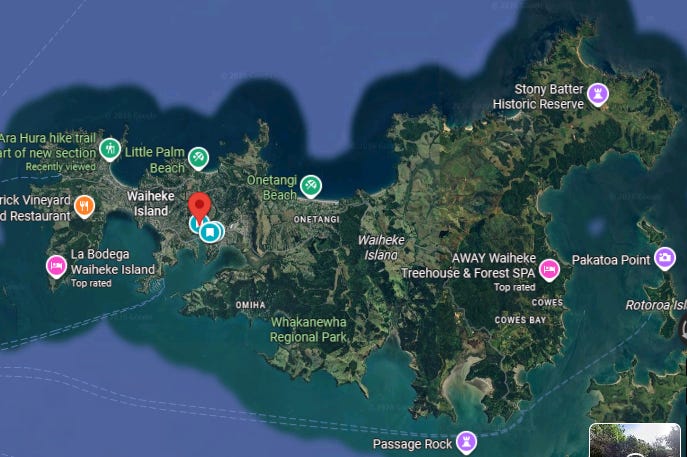
The red pin. Firmly in the more populated western side.
It is a relatively secluded area, but also there are houses on either side. It’s firmly in the middle.
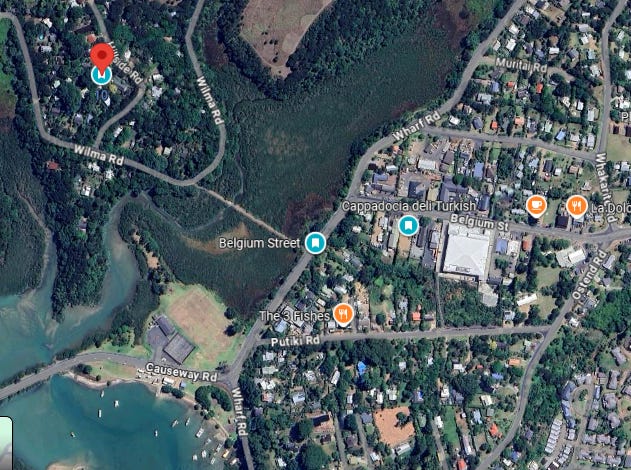
Belgium Street is a bus stop. The WhatsApp messages place it s about a 10 minute walk away from the Pōhutukawa House. It’s less than half an hour to the ferry from the bus stop.
There’s Capadoccia Deli Turkish, a place for a sandwich etc, less than 15 minutes walk away.
In addition there appears to be a commercial area with stores and bar a few minutes further.
As you can see, this is not a remote area. It’s semi-rural. More space than in Auckland, but you don’t have to drive 5 miles to visit your neighbours as in most of NZ.
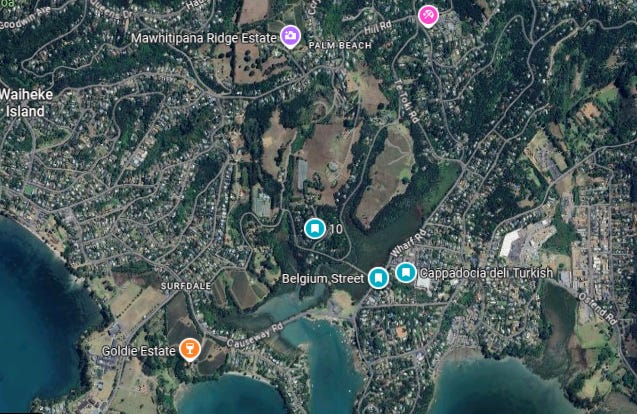
At any time Pavlovich was a mere 10-15 minute walk from civilisation, public transport etc. She could have also walked or cycled into the more central areas. .
Rich Man’s Island?
Returning to Lila Shapiro’s quote.
Waiheke Island, a lush bohemian retreat with vineyards, golden beaches, and more than 60 helipads to accommodate the billionaires who vacationed there.
Again, you’d be forgiven that the entire island population was made up of billionaires and their butlers.
It has had an influx of silicon valley types looking for ‘‘safe-haven’’ investments. Figures like Graeme Hart, Mihai Dinulescu. Peter Thiel owned land there, but sold up.
The actual picture of Waiheke is a little more boring than Shapiro’s lurid brushstrokes would like to paint. The median income is actually lower than in most of the country for the simple reason that most people are retired. The median age is 48.9 years versus 38.1 nationally. Only 45% are employed full time.
This is an island overrun by asset-rich retirees.
It’s not a private island. As to vineyards, the entirety of New Zealand is a wine producing region. If you didn’t know that, it might make it seem fantastically posh. When Waiheke is in fact only moderately posh.
Some of the helipads are for ferrying high-class clientele. But also there is no hospital on the island, just a limited medical center. If you have an emergency, it’s likely you’ll want to be airlifted. In any case, Gaiman and Palmer took the ferry, rather than a chopper.
Waiheke is a tough place for the average worker to survive or the ordinary family, and rents are ever-increasing. This has led the local community being increasingly pushed out, and it’s changed over time.
Rather than a ‘‘playground for the super-rich’’ per se, this is a more a place where you need a lifetime’s worth of assets or else find yourself under pressure to head elsewhere. It’s not the Hamptons or Monaco, but highlights a more banal, less ostentatious form of wealth. And unfortunately, it’s a pattern that’s seen across a lot of similar satellite areas.
It’s definitely not chosen because it’s ‘‘remote and difficult to access’’ as Pavlovich claimed, but rather the opposite.
Living on Waiheke gives the asset-rich resident the opportunity to visit a dense population center with food and entertainment, and then retreat to a quiet little place with beautiful views.
It feels out of the way, but it’s not, and that’s the attraction.
So Why Say It’s Remote?
With these attempts to stretch comparisons to other ‘‘rich man islands’’ no matter how far flung, Pavlovich also wanted to paint a picture of herself as isolated, as trapped, as completely within Neil Gaiman’s power. A situation where verbal consent might be considered meaningless.
However, it’s only possible to create this impression with some rather striking omissions.
Next week I’ll reveal the previously unpublished documents that show she travelled back and forth from her Auckland apartment to the island many times over the three week period, completely overturning any notion that she was ‘‘trafficked’’ or otherwise trapped on the island.
I welcome constructive feedback to strengthen this work:
Please keep comments under 200 words so I can feature as many as possible.
If wording is unclear or could be misinterpreted, I’ll revise for clarity.
If you spot a factual or logical inconsistency, I’ll gladly correct or refine it.
Abuse or bad-faith commentary will not be tolerated.
📩 Send contributions to: neil_gaiman_is_innocent@mail.com
💬 Feel free to chat — whether it’s thoughts, questions, or just reflections, we’d love to hear from you at r/NeilGaimanIsInnocent
Click here to make a one-off financial contribution to the research project.
✦ Next Up
Coming Soon.