
Neil Gaiman Is Innocent
A Hellscape of Smoke, But Where's The Heckin' Fire?

New evidence has come to light about Neil Gaiman. By now every person on the planet, and some on Mars, must have heard of the awful, monstrous, heartbreaking, terrifying allegations against the (formerly) beloved storyteller.
The problem is, as with that Tortoise Media podcast Master which broke the story, few have gone to the trouble of reviewing the source material, instead relying on the ongoing social media commentary to make up their minds. Even those that have rarely go through it in detail asking what is solid and what is spin.
Neil Gaiman is innocent. I don’t mean that in just the legal sense he hasn’t been found guilty of a crime, or that he won’t be found guilty of one in future (though these are important points that we should not lose sight of). But in the wider moral sense of not being a sexual predator.
Shocking as it sounds, there is no compelling evidence against him. There is a great deal which exonerates him. And there is a lot that indicates an alternative explanation. In public discourse there is an avalanche of insinuation and ‘filling in the blanks’, mostly coming from the entirely problematic Master. There are accusations of differing nature from 5 women, out of hundreds contacted, and they are often strikingly obscurationist in what they are actually alleging.
There is also a compelling counter-narrative that leaps out naturally in the primary evidence, an obvious interpretation that is systematically suppressed, ‘smoothed over’ and hastily explained away in the various commentaries.
This will be a multimedia project, with music and graphics, WhatsApp messages and videos. This is in part because the subject matter is so heavy, a lot of people will switch off without some form of relief. I’m going to do my best to lighten things up every now and then.
The above album is from Facing The Waves: Transforming Political Chaos through Art by Igor Goldkind, anti-fascist comic artist, author and poet who has known Neil Gaiman and his circle for many years.
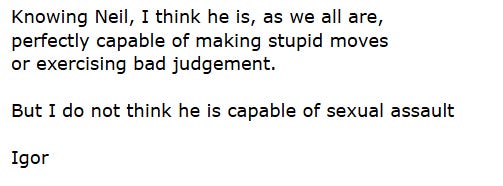
Over the course of this series I will explain everything in detail. Please, if you can, read them sequentially before making up your mind. It’s a complicated, evocative, emotionally charged case on the surface, but the core issues are actually very simple.
Throughout, I’m trying to keep it logical. But I’m also a human being. I feel shock, frustration, disgust just as most people. Sometimes I’ll make an aside in italics to show that I’m talking about how something affected me personally. I’ll give an ‘educated guess’ as to what went down.
I know these are sensitive issues. I’m talking about rape, abuse, human trafficking. These are the nightmares that haunt us, so it might be harrowing. But the actual events seem to diverge from the horror that these labels denote.
We can still take women’s rights seriously, even while being comfortable saying that not every single allegation of sexual misconduct is true. Even the author of the ‘Shitty Media Men’ list which circulated around Hollywood women in the wake of Harvey Weinstein’s dethroning put the following disclaimer:
“This document is only a collection of misconduct allegations and rumors. Take everything with a grain of salt. If you see something about a man you’re friends with, don’t freak out.” - Shitty Media Men quoted in Slate
#Metoo can get it wrong sometimes and still be valid. Not every allegation needs to be true. Enough of them are. But we need to make an honest, good faith attempt to separate truth from rumour and spin. Neil Gaiman never made the list.
If you care about this at all, put in the time. Listen to the Tortoise Media podcast yourself, if you can. Its hard to get through it and doesn’t appear designed to really be listened to. It can help to stop it, pause, rewind. Really think about what’s being said.
I’m not exaggerating when I say it is the most frustrating piece of media I have ever had the displeasure of consuming. You could also look at the court documents, which I’ll provide, and this balanced personal critique of Master from Council of Geeks.
If you've previously leapt to judgement about Neil Gaiman, please come to this with an open mind. All we know about the situation is what others have told us.
In Master, the alleged victims sometimes make highly emotional pleas, alongside a pushy narration which tells us how we are supposed to interpret these voices, all the while playing sinister, suggestive background music.
We tend to feel sympathy for the women interviewed here, but they are rarely just allowed to speak without editing and over-narration. When you actually look at their words line-by-line, cross-referenced with other available sources, in detail and the stories emerge, there’s a veritable hellscape of smoke, but the fire? They can still come across as sympathetic figures, just not in a way that establishes Gaiman and former wife Amanda Palmer as guilty of wrongdoing.
He appears conscientious, caring and emotionally supportive towards his accusers, as if desperately trying to make sense of what they are saying, not wishing to deny their experiences as women, but never-the-less, baffled.
THE PARAPET
You'll probably be wondering who I am. I'm an NUJ accredited journalist, I've worked for a number of left-wing news sites over the years. Today I am a relatively boring technology writer, working for trade magazines, with a particular focus on environmental technologies.
I've been a radical left-wing activist all my life. I don't know Neil Gaiman. I am also not really familiar with his work. So I'm not a fan, or a detractor in that sense. I'm not being paid any money for this except for subscriptions.
I am also conscious that I am putting my head above the parapet by writing this series. It wasn’t an easy decision. I understand our dynamics as a movement quite well. I realised that my reluctance was itself an imperative to speak out. If I feel undue pressure to remain silent, then surely others do too.
As a journalist, it is my job to ask hard questions and bring facts to light, or at the very least point out what others are afraid to say. As a leftist I want us to always be raising the bar, expanding our ideas of fairness, conducting some honest self-reflection and continuing to shine a light in the world.
If I do have any skin in the game, it's that Neil Gaiman is a left-wing figure who has always promoted our causes with sincerity. It’s much harder now for him to take a stand. His voice is muted and discouraged. We’ve become very good at alienating our own people.
If we on the left have got Neil wrong its a massive 'own goal'.
A SHOT FIRED FROM THE RIGHT
The original podcast came from Tortoise Media, a largely unknown media company with a lot of money behind it. Britain’s oldest running Sunday paper, the Observer, has now been sold to Tortoise, prompting strikes across Scott Trust owned outlets like the Guardian. Its been called an ‘act of cultural vandalism’ and a ‘digital coup’. Touted as Trump-aligned ‘broligarchs’ they are an unknown quantity and are garnering huge power to shape the media landscape.
‘‘What happened to me is a playbook, and its now coming for all sorts of other people.” - Caroline Cadwalldr
Rachel Johnson, who originally broke the story with Master, is decidedly not a left-winger. Extraordinarily, she is the sister of Boris Johnson, former Prime Minister of the UK and prominent media personality in her own right.
As PM, her brother has courted right-wing, quasi-fascist elements of the British public, and been the subject of sexual misconduct allegations himself. She has defended him. She states that she has different politics, although apart from obvious disagreements like Brexit, I really can't tell the difference.
Rachel Johnson's political connections do not invalidate anything put forth in Master. It’s the presentation, content and contradictory nature of both narration and sources which casts doubt on it. Despite the questionable production, its still necessary to dig down into the facts, and to treat them as self-standing, at least initially.
What are Rachel Johnson’s real views like?
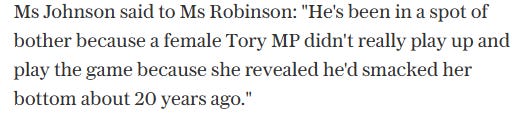
Its all rather suggestive of ulterior motives (she’s made statements which appear designed to deflect this interpretation). Furthermore, she always seems distinctly nervous in interviews about Master, as if expecting to be found out at any moment. At the very least she made sure the allegations were presented in a more one-sided manner than a politically neutral figure would.
More on her father, Stanley Johnson’s ‘spot of bother’:
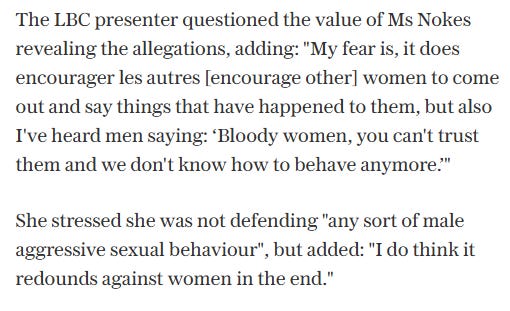
Despite covering a lot of feminist talking points in Master (poorly), she doesn’t particularly come across as a feminist. If it is, its a particularly tone-deaf form that punches down, absolutely disinterested in the suffering of women outside her elite circles. Her views are the views of a toff, a member of the British establishment. Her 2008 novel which won the Bad Sex awards is replete with references to ‘pony mad children’ and ‘particularly smackable bottoms in jhodpurs.’
Her original aim, I believe, was that she wanted to show the left to be hypocrites. She believed that we would not ‘cancel’ one of our own. Well, she was wrong. And now she’s the one who looks like a hypocrite for judging Neil on different standards to her father and brother.
Given the absolutely scarcity of damning evidence I really wish she’d been right, and it had just been yet another puerile potshot in the culture war. Perhaps just a little hypocrisy as an inoculant wouldn’t be a bad thing on our part.
Gaiman champions the causes which her brother tears to pieces, such as refugee justice and human rights, and ironically #Metoo and feminism. Rachel Johnson was a candidate for Change UK, a Tory party spin-off that quickly garnered a reputation for racism. She tends to promote a vision of feminism that pits it against religious and ethnic minorities, as you can see here.
And then she has these ‘cosy’ chats with figures like Nigel Farage. For those who don't know British politics, he is the leader of far-right party Reform.
One of the purposes of this series is to bring an element of critical thinking to our debates about public figures. So I want to make it clear, Rachel Johnson, despite her politics, could have presented this factually, neutrally, fairly. Nothing about Master is thrown out just because of who produced it. She is a journalist, so she is capable of presenting a balanced series.
I will show that she has not done that. And I will leave you to judge why someone with her politics may not have presented Neil Gaiman in a fair light.
Looking decidedly uncomfortable as they try to justify Master, Rachel Johnson with co-host Paul Caruana Galizia:
SCHRODINGER’S SURVIVOR
When we believe someone is a victim of a serious crime, especially a sexual crime, there is tendency to not want to probe too far into their story. Scrutinising their words, their actions, their proclivities can feel ‘hostile’, like we’re trying to catch them out.
Not pushing, not pressing, not questioning seems supportive, kind. Nobody will really get publicly criticised for not asking questions. But if we never believed someone in the first place, we might have the opposite problem. We’d question things that are reasonable, we’d place too high a burden of proof and remain skeptical even in the face of good evidence.
So confirmation bias plays a huge part in these sorts of cases. When I first began I tried to take an approach I call “Shrodinger’s Survivor”. Like the cat in the famous physics thought experiment, the accuser is conceived of as both a genuine victim and and a false claimant at the same time.
As time went on, I became more certain that the claims were bogus, or at least very distorted. From that point on there was more opportunity for confirmation bias, and I’m aware of the sort of affect my current certainty might have on the reader.
My only suggestion would be to absorb everything you can with an open mind, then take as much time as needed to self reflect, do your own research, and come to your own conclusions.
RAISING THE BAR
There is a lot of ground to cover. I'll be looking at the claims of each of the alleged victims in turn (in installments), and asking whether they stack up, what they actually say, and to what extent Gaiman’s alleged behaviour might constitute criminality, immorality and psychopathology.
I will also be mentioning NDAs, whether they happened in every case that is claimed, whether an NDA is itself a smoking gun. I also have some comments to make on Moral Panics, as set forth by Stanley Cohen, and our tendency to characterise people as ‘Folk Devils’ in ways that go far beyond the evidence.
And finally, separate to the investigatory aspect some personal thoughts to get off my chest about Gaiman as an individual, and what may have led to him into such hot water, only after I’ve shown he is innocent of wrongdoing.
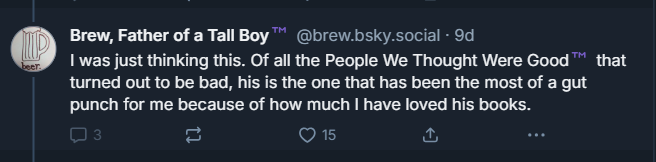
I set myself the following criteria: all I need to do is find is a single, well evidenced claim of a heinously immoral act, that would totally change the way I think about Neil Gaiman. Close second is something that as yet remains unproven, but could be strong evidence of such if brought out in a court case, that would constitute a genuine ‘watch this space’ moment.
Some commentary has stated words to the effect of ‘even if he didn’t commit sexual crimes, he was a powerful man having sex with younger, vulnerable, economically dependent women’. I won’t get too far into the morality of that.
There is a distinction between heinous, criminal, psychopathic acts and age-gap relationships, or between rich and poor, and we shouldn’t conflate them. Also, he was married to Amanda Palmer, an age-gap relationship of some 20 years. Not too long ago, this was a celebrated, progressive relationship.
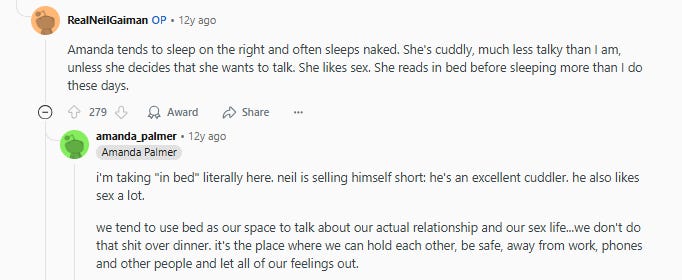
If, despite innocence as to the criminal aspects of the allegations, the reader is still motivated to condemn Gaiman in the same vein as Leonardo De Caprio, that’s just beyond the scope of what I’m discussing here. Save that discussion for another day.
If you want to be fair to all parties you should hear their accounts and treat them equally. If someone lies, they invariably leave a gap, something that doesn't make sense, that can be investigated until their story falls apart. So if you really think Neil Gaiman is guilty, there should be no downside to hearing him out.
But as it stands, I haven’t felt the need to include a great deal of what he says in official statements, relying more on his WhatsApp messages. Real accounts are richly detailed, and this is the most universally acknowledged scientific indicator of veracity. Those who stray from the truth tend to be unable to describe events in detail but instead keep it vague.
CRITICAL THINKING
I'm not a lawyer. I’ve been arrested dozens of times on environmental protest marches and direct actions. I’ve been hauled through the courts myself and sat in on friends’ trial. This gives me a basic insight into how these institutions work, but not expertise. If someone with the necessary legal knowledge were to expand on anything said here, that would be an excellent way of opening up the conversation. I'm also not a psychologist or a psychiatrist.
What I’m good at is inference, and spotting inconsistencies. If something doesn’t stack up, I’m on it in a second. I’d encourage anyone with an interest to get into critical-thinking, defined by the Oxford English Dictionary as:
“The objective, systematic, and rational analysis and evaluation of factual evidence in order to form a judgement on a subject, issue.” - Encyclopedia Britannica entry
I would stress that’s an ideal, and the one I started with at the outset. There’s every chance I run into my own inconsistencies, and blind spots. So long as its in good faith, I have no issue with anyone pointing these out, or even better presenting a reasoned counter-argument. If you’ve got what it takes, use the email provided at the bottom of this article.
It’s difficult not to weave some kind of narrative, or to build off of inferences. I go back to evidence as often as possible, and this is an evolving document.
As much as one wants to sympathise with those who are claiming victimisation from the outset, notions such as ‘I believe survivors’ or ‘I believe all women’ can be used to justify lazy journalism, and I’m not prepared to give right-wing attack dogs like Rachel Johnson a pass.
We can’t claim that a lack of critical thinking is ethics. What we need to do is open the space for survivors to make their statements in full without being shut down or pre-judged. Critical thinking means listening with an open mind, then asking everything we can about the events described so as to come to the best assessment of the truth.
Emotional and moral appeals can be made after the truth of events is established, otherwise we don’t know who can legitimately be thought of as a survivor or a victim. I believe in proof and reasonable argument and I think you should as well.
Compassionate skepticism to all parties is healthy, it is fair, and I will happily defend my position to anyone who thinks I should not have written this series.
🤝 I welcome constructive feedback to strengthen this work:
Please keep comments under 200 words so I can feature as many as possible.
If wording is unclear or could be misinterpreted, I’ll revise for clarity.
If you spot a factual or logical inconsistency, I’ll gladly correct or refine it.
Abuse or bad-faith commentary will not be tolerated.
📩 Send contributions to: neil_gaiman_is_innocent@mail.com
💬 Feel free to chat — whether it’s thoughts, questions, or just reflections, we’d love to hear from you at r/NeilGaimanIsInnocent
🪙 Click here to make a one-off financial contribution to the research project.
✦ Next Up
An Introduction to Scarlett Pavlovich